
- What It Covers: Connectivity for people, vehicles, and equipment across one network
- Network Scale: More than 44 million connected devices, the most of any North American provider
- 5G RedCap Reach: Over 200 million points of presence across the US
- Core Platforms: AT&T Control Center for SIM management, IoT Connectivity Management for global deployment
- Who It Serves: Everything from a two-van operation to a national fleet
Mobility Is Bigger Than Phones
Ask most owners what mobile connectivity means to their business and they will describe a phone bill. That was accurate ten years ago.
Today AT&T Business carries more than 44 million connected devices across North America, and most of them are not phones. They are shipping containers, medical equipment, delivery vans, bikes, sensors, and cameras.
Understanding mobility as a category rather than a phone plan changes what you look for. The question stops being how much per line and becomes what in my business needs to report back, and from where.
The Three Things Businesses Connect in AT&T Business Mobility
Every mobility deployment falls into one of three buckets. Most businesses start with the first and expand outward.
| Category | What It Covers | Typical Trigger |
|---|---|---|
| People | Phones, tablets, and wearables for staff | Team outgrows personal phones |
| Vehicles | Fleet tracking, engine diagnostics, driver logs | Compliance requirements or fuel costs |
| Things | Sensors, cameras, equipment, and containers | Something valuable moves and nobody knows where |
Connecting Your People
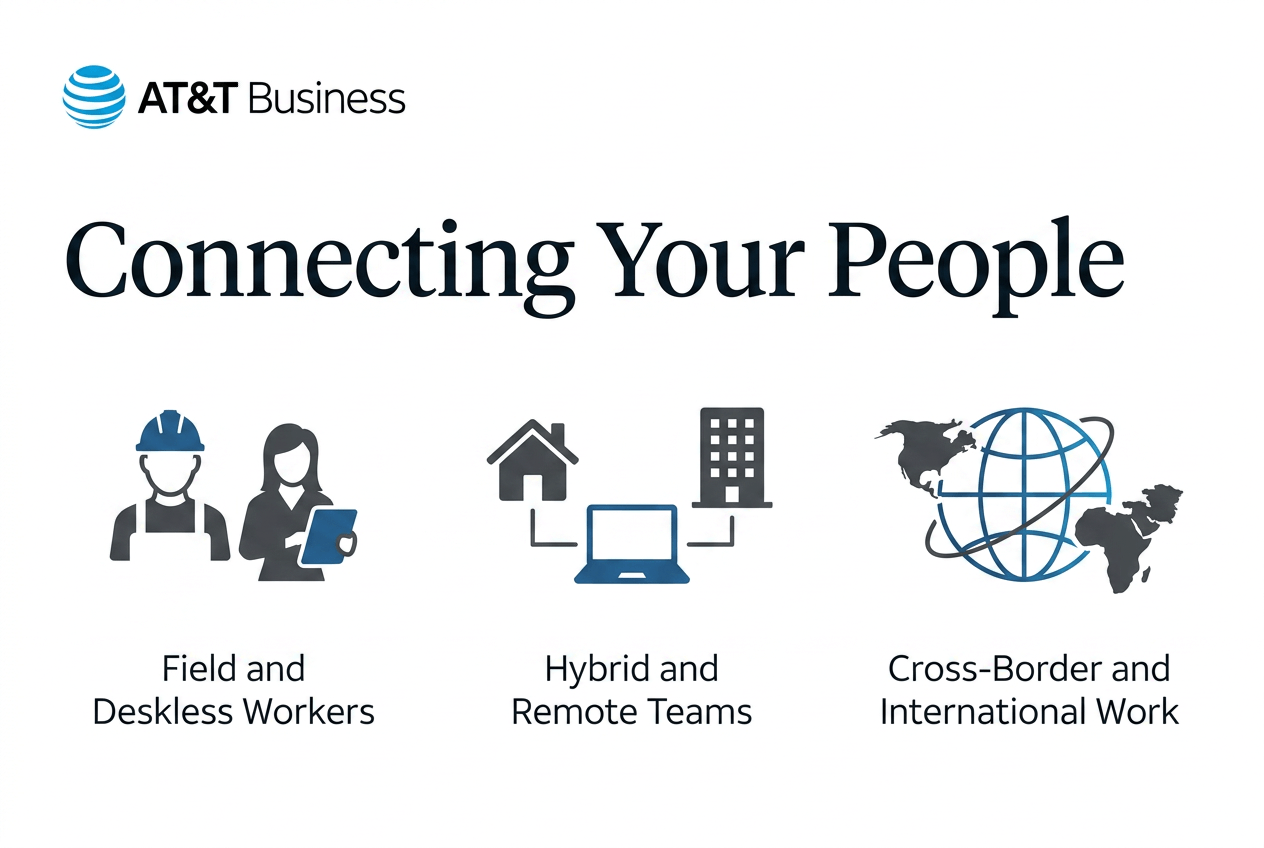
Field and Deskless Workers
The staff who never sit at a desk are the hardest to support and the most dependent on coverage. Technicians, drivers, inspectors, and crews working across a wide territory need consistent service well outside city centers, plus hotspot capacity when there is no other connection available.
Hybrid and Remote Teams
For anyone splitting time between home, office, and client sites, mobility becomes the fallback layer. Hotspot data covers the day the home internet drops, and 5G backup keeps a location online when the fixed line fails.
Cross-Border and International Work
Unlimited talk, text, and data across the US, Canada, and Mexico covers regional operations without add-ons. International Day Pass for Business handles travel beyond that on a per-day basis rather than a permanent plan change.
Connecting Your Vehicles
This is where mobility stops looking like telecom and starts looking like operations.
IoT Fleet Management covers vehicle tracking, engine diagnostics, and driver behavior data. For anyone regulated by the Federal Motor Carrier Safety Administration, it includes Electronic Logging Device solutions that automatically record driving time and Hours of Service records, which is a compliance requirement rather than a nice-to-have.
Most vehicle types are supported. Older vehicles may return less engine data, and for vehicles without the standard diagnostic connector, AT&T supplies harnesses that connect into the port.
The practical value is not the tracking dot on a map. It is knowing which van is closest to an emergency call, why fuel spend rose 12% last quarter, and whether a driver is due a rest break before dispatch schedules them.
Connecting Your Things in AT&T Business Mobility
The IoT side is where scale changes the tooling. Managing four phones is an account. Managing four thousand sensors is a platform problem.
- AT&T Control Center, powered by Cisco Jasper, automates SIM management at scale with real-time data monitoring
- IoT Connectivity Management deploys and optimizes connections across cellular and satellite operators globally
- Global SIM connects and manages devices across countries on a single SIM rather than per-region contracts
- Asset tracking for containers, equipment, and inventory that moves between sites
- 5G RedCap coverage across more than 200 million points of presence in the US
- FirstNet compatibility extends connectivity to certified public safety routers, cameras, and sensors
The recurring theme is provisioning and visibility. Anyone who has tried to work out which of 200 SIMs is burning data understands why the platform matters more than the per-device rate.
Plans and Solutions by What You're Connecting
| What You're Connecting | Plan or Solution | What It Delivers |
|---|---|---|
| Staff phones | Business Unlimited Starter, Advanced 3.0, Premium 2.0, Ultimate 3.0 | Unlimited talk, text, and data with a tier assigned per line, mixed across one plan group |
| Tablets | Business Unlimited Premium for Tablet | Adds a tablet line to an existing plan group, with a discount available on one per group |
| Wearables | Business Unlimited for Apple Wearable or Android Wearable | Connects a smartwatch independently of the paired phone |
| Mobile hotspots | Hotspot data on eligible wireless tiers | Backup connectivity for laptops, POS terminals, and job sites |
| Priority data users | AT&T Turbo for Business | High-priority data for lines that cannot tolerate congestion |
| Fleet vehicles | IoT Fleet Management | Vehicle tracking, engine diagnostics, and driver behavior data |
| Regulated fleets | Electronic Logging Device solutions | Automatic Hours of Service records in line with FMCSA rules |
| Equipment and containers | Asset tracking | Location and status for assets moving between sites |
| Sensors and machines | IoT connectivity plans | Cellular connectivity for low-power devices reporting at scale |
| Large device fleets | AT&T Control Center | Automated SIM management with real-time monitoring |
| Global deployments | IoT Connectivity Management and Global SIM | One SIM managed across cellular and satellite operators worldwide |
| Public safety devices | FirstNet certified routers, cameras, and sensors | Dedicated connectivity for public safety operations |
The pattern to notice: phone lines, connected devices, and IoT endpoints are priced and managed differently, so a growing business usually ends up running more than one of these at once rather than migrating from one to the next.
The Infrastructure Underneath
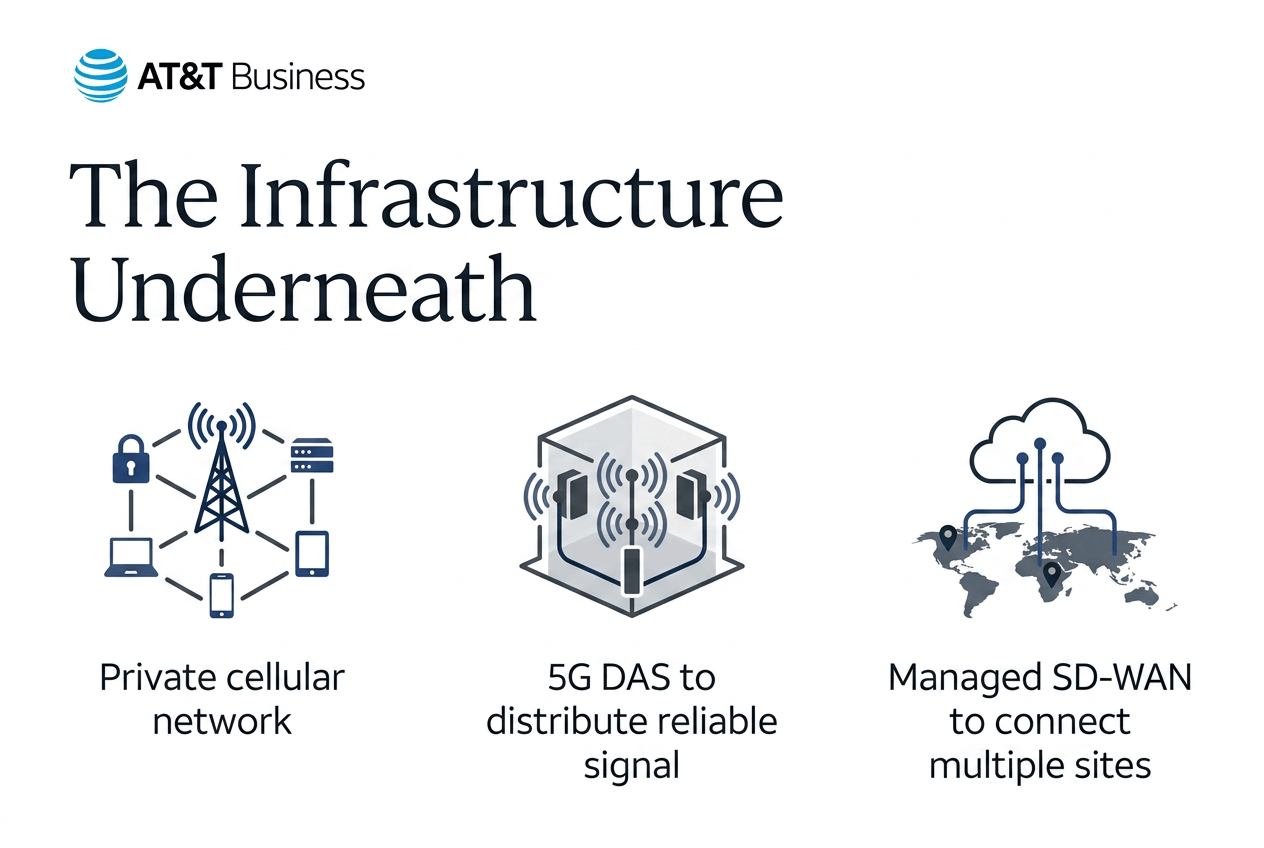
For larger deployments, mobility connects to the wider network stack rather than sitting apart from it.
- Private cellular network for facilities that need dedicated coverage and control on site
- 5G DAS to distribute reliable signal through large buildings, warehouses, and venues
- Managed SD-WAN to connect multiple sites with centralized traffic control
- SASE and network embedded security to protect traffic across distributed endpoints
- Mobility and 5G consulting for organizations designing a deployment rather than buying off a menu
Managing the Devices
Once you connect more than a handful of things, management becomes the ongoing job rather than a one-time setup.
Device management services cover enrollment support, trade-in eligibility, and installment plans, so devices refresh on a predictable cycle rather than whenever one breaks. AT&T Business Protect adds device protection for phones, tablets, and select devices across the continental US, Alaska, Hawaii, and DC, with coverage for accidental damage from handling such as drops and spills. Loss and theft are not included, which is worth knowing before you assume you are covered.
Where Small Businesses Fit
Nothing here is exclusive to large enterprises, which is the point worth making.
A two-van plumbing operation running ELD-compliant logs and a landscaping crew tracking equipment between sites are both doing mobility, at a scale that would have required an enterprise contract a decade ago. Fleet tools and asset tracking scale down as readily as they scale up.
If what you actually need right now is phone lines and pricing for a small team, that is a different question with a different answer, and it deserves its own comparison rather than being folded into a solutions overview.
Switching Coverage: Four Steps
Moving mobile service to AT&T Business follows the same process regardless of size.
- Check your devices are eligible and still active with your current provider.
- Gather your current account number and Number Transfer PIN or passcode.
- Choose your plan or device, and if you are keeping your phone, confirm it is unlocked.
- Let the transfer complete. Your old service disconnects automatically once the number transfer finishes.
Switching offers include up to $800 per line via reward card, with redemption required.
Frequently Asked Questions
What does business mobility actually mean?
Connectivity for anything that moves, including staff phones and tablets, vehicles, and equipment or sensors reporting back from the field.
How many devices does AT&T connect?
More than 44 million connected devices across North America, more than any other provider in the region, spanning vehicles, machines, containers, and medical equipment.
Can fleet tracking help with compliance?
Yes. IoT Fleet Management includes Electronic Logging Device solutions that record driving time and Hours of Service data in line with FMCSA rules.
What is AT&T Control Center?
A Cisco Jasper-powered platform that automates SIM management at scale with real-time monitoring, used for managing large device fleets rather than a handful of lines.
Does device protection cover a lost phone?
No. AT&T Business Protect covers accidental damage from handling such as drops and spills, but loss and theft are not included.
Final Verdict
The useful shift is to stop thinking about mobility as a phone bill and start thinking about it as an inventory question. What in your business moves, and what do you currently not know about it while it is out there?
For some businesses the answer is only staff phones, and that is a straightforward buy. For others it is six vans, a trailer of equipment, and a set of sensors on machinery, and that is a different conversation involving fleet tools, asset tracking, and a management platform. AT&T Business covers both ends of that range on one network, which matters mainly because the second scenario tends to grow out of the first without much warning.