
Not long ago, most products became popular through traditional advertising, word-of-mouth recommendations, or years of gradual brand building. Today, an ordinary water bottle, kitchen gadget, cleaning product, or home accessory can become a nationwide sensation almost overnight.
A single TikTok video can generate millions of views. An Instagram Reel can send shoppers scrambling to Amazon. A YouTube creator can turn an unknown product into a bestseller within days.
The speed at which products go viral today is unlike anything consumers have seen before.
So why are everyday products spreading faster than ever?
The answer lies in a combination of technology, social media algorithms, consumer behavior, and the way people now discover products online.
Product Discovery Has Moved to Social Media
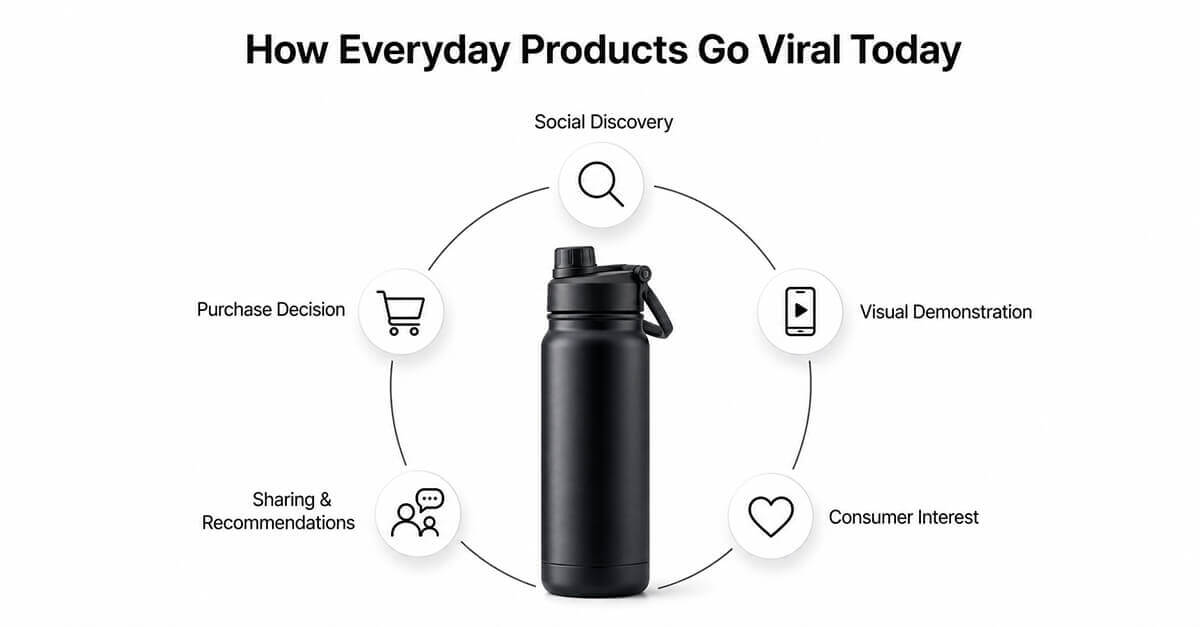
For decades, people discovered products through television commercials, magazines, newspapers, or retail stores.
Today, discovery happens inside social media feeds.
Instead of actively searching for products, consumers encounter them while scrolling through TikTok, Instagram, YouTube Shorts, Facebook Reels, and other content platforms.
This shift has fundamentally changed how products gain attention.
A person may not be looking for a new water bottle, robot vacuum, or skincare tool. Yet after seeing dozens of creators using the same product, curiosity naturally develops.
The purchase journey often begins long before a customer actively starts shopping.
Algorithms Reward Shareable Products
Social media platforms are designed to maximize engagement.
Algorithms prioritize content that generates:
- Views
- Likes
- Comments
- Shares
- Watch time
Certain products naturally perform well within these systems.
Products that demonstrate visible transformations, solve common problems, or create satisfying before-and-after moments often receive disproportionate attention.
Examples include:
- Cleaning products removing stubborn stains
- Organization gadgets transforming cluttered spaces
- Kitchen tools simplifying food preparation
- Smart-home devices automating everyday tasks
The more visually impressive a product appears, the more likely algorithms are to amplify its reach.
Consumers Trust People More Than Advertisements
One of the biggest reasons products go viral faster today is trust.
Traditional advertising often feels promotional.
Social media content frequently feels personal.
Consumers increasingly rely on:
- Creator recommendations
- User reviews
- Real-life demonstrations
- Product experiences
When viewers see someone genuinely using a product rather than reading from a scripted advertisement, the recommendation often feels more authentic.
Whether that perception is always accurate is another discussion entirely, but the impact on purchasing decisions is undeniable.
People trust people.
That simple reality accelerates product adoption.
Amazon Makes Buying Immediate

In the past, discovering a product and purchasing it often involved multiple steps.
Today, the process can take less than a minute.
A user watches a TikTok.
They click a link.
They land on Amazon.
The order is placed.
The convenience of modern e-commerce has removed much of the friction that once slowed purchasing decisions.
Products that generate curiosity can convert into sales almost instantly.
This speed contributes significantly to viral growth.
For example, Amazon's Best Sellers section regularly highlights products that have benefited from sudden spikes in online attention.
Amazon Category: Amazon Best Sellers
Explore Trending Products:
https://www.amazon.com/Best-Sellers/zgbs
FOMO Plays a Major Role
Fear of Missing Out, commonly known as FOMO, remains one of the strongest psychological drivers behind viral trends.
When consumers repeatedly see a product appearing in:
- TikTok videos
- Instagram posts
- YouTube reviews
- Product roundups
- Recommendation lists
they naturally begin asking questions.
- Why is everyone buying this?
- What makes it special?
- Am I missing something?
Even if consumers do not purchase immediately, repeated exposure increases familiarity and interest.
Eventually, curiosity often becomes action.
Everyday Products Are Easier to Adopt
Most viral products are not expensive luxury purchases.
They're usually simple, practical items.
Examples include:
- Water bottles
- Tumblers
- Kitchen gadgets
- Cleaning tools
- Smart-home accessories
- Wellness products
The lower the barrier to entry, the easier it becomes for large numbers of people to participate in a trend.
A $30 gadget is far easier to purchase impulsively than a $3,000 appliance.
This accessibility helps viral momentum build quickly.
Short-Form Video Accelerates Product Demonstration
Before TikTok and Reels, product demonstrations often required long videos or detailed reviews.
Today, creators can showcase a product's value in under thirty seconds.
A viewer can immediately understand:
- What the product does
- Why it's useful
- How it solves a problem
This rapid communication dramatically increases the speed at which products spread.
The best viral products often require almost no explanation.
Their value becomes obvious within seconds.
Consumers Love Sharing Discoveries
People naturally enjoy recommending products they find useful.
Social media makes this easier than ever.
When someone discovers a product that genuinely improves their routine, sharing that discovery becomes part of the experience.
Recommendations spread through:
- TikTok videos
- Instagram Stories
- YouTube reviews
- Facebook groups
- Online communities
Each recommendation introduces the product to a new audience.
The cycle continues until a trend reaches mainstream awareness.
Final Thoughts
Everyday products are going viral faster than ever because the way consumers discover, evaluate, and purchase products has fundamentally changed.
Social media algorithms amplify engaging content. Creators provide demonstrations that feel authentic. Amazon enables immediate purchasing. Consumers willingly share products that improve their lives.
The result is a marketplace where an unknown item can become a bestseller in days rather than years.
While not every viral product deserves the attention it receives, the speed of modern product discovery shows no signs of slowing down. As social commerce continues to evolve, everyday products will likely become even more influential — and even more viral — in the years ahead.