
A furnace dying in the middle of January has a way of turning "should I get a home warranty" into an urgent question rather than a someday task. American Home Shield is usually the first name that comes up in that search, and for good reason, it's been in this business since 1971, longer than any competitor still standing.
What American Home Shield Actually Is
Founded in 1971 and now operating under Frontdoor Inc, American Home Shield built out the largest contractor network in the home warranty industry over more than five decades in business. Coverage is available in all 50 states, which is more than several competitors can claim.
Being the oldest name in the space doesn't automatically make it the right fit for every house, though. Older homes with aging systems tend to benefit most from deeper coverage caps, while newer homes with fewer things likely to break may not need the most expensive tier available.
American Home Shield vs. Choice Home Warranty
| Parameter | American Home Shield | Choice Home Warranty |
|---|---|---|
| Coverage Options | Three tiers, from systems-only up to full coverage plus roof leaks | Two plans, appliances bundled in from the start |
| Pricing | Moderate, typically $50 to $85 a month | Generally cheaper monthly premiums |
| Claims Response | Standard 48-hour first contact window | Faster, advertises contact within about 4 hours |
| Coverage Caps | Higher payout ceilings, especially on the top tier | Lower caps, more standardized across plans |
| Best For | Older homes, owners who want plan customization | Budget-focused homeowners who want speed and simplicity |
Neither company wins outright across every category. American Home Shield makes more sense when coverage depth and contractor availability matter more than shaving a few dollars off the monthly bill. Choice Home Warranty tends to appeal more to homeowners who value a faster first response and a simpler plan structure over deep customization.
Benefits of Choosing American Home Shield
- Largest contractor network in the industry, available in all 50 states
- Three plan tiers let you match coverage to your home's actual age and needs
- Choice of service call fee lets you balance monthly cost against per-visit cost
- Higher payout caps than many competitors, especially on the top-tier plan
- Around-the-clock online claims portal for filing at any hour
Plans and Pricing Breakdown
The Three Tiers
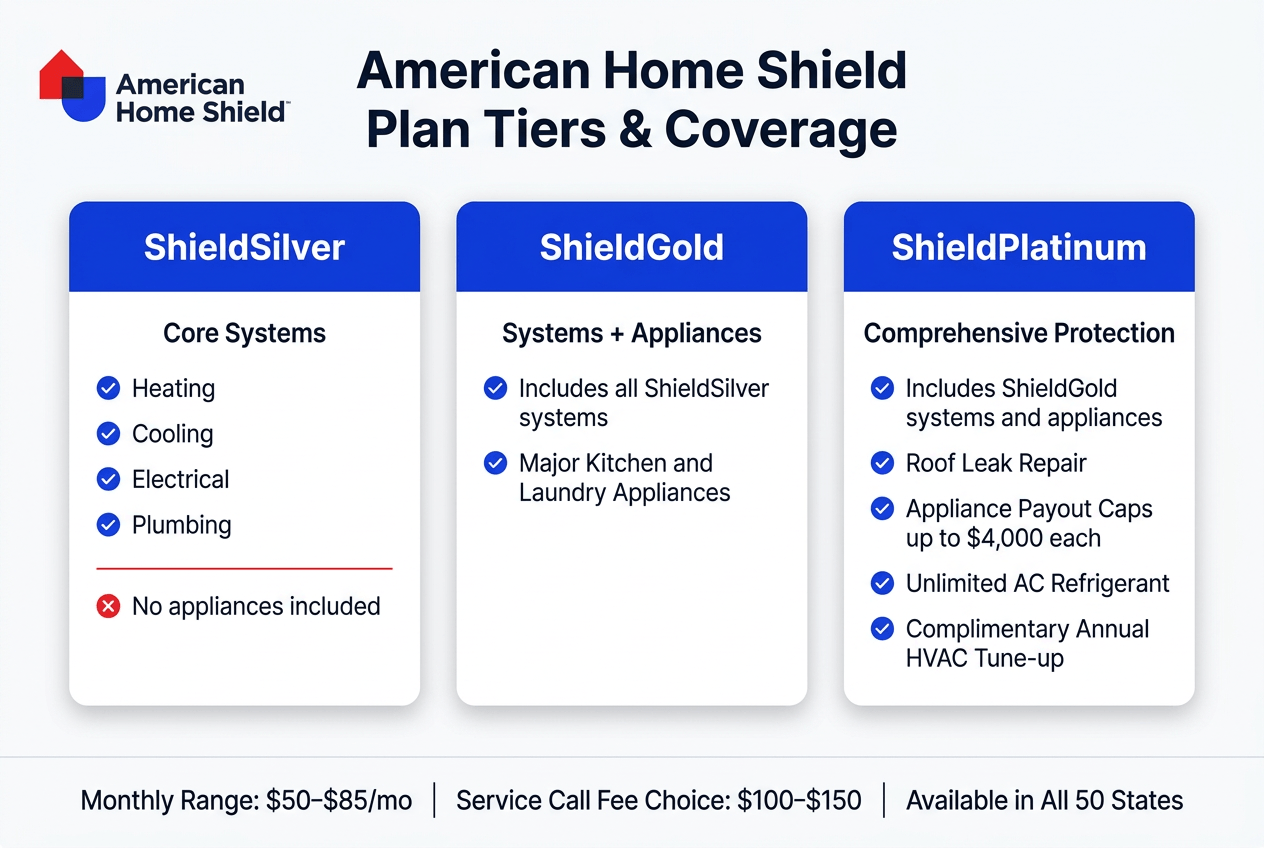
ShieldSilver covers core systems only, heating, cooling, electrical, and plumbing, with no appliances included. ShieldGold builds on that by adding kitchen and laundry appliances into the same plan. ShieldPlatinum sits at the top, adding roof leak repair coverage and pushing appliance payout caps up toward $4,000 each, along with unlimited AC refrigerant and a complimentary annual HVAC tune-up.
What It Actually Costs
Monthly pricing typically falls between $50 and $85, though promotional pricing can bring the entry cost down further. You also select a service call fee, usually landing between $100 and $150, and picking the higher fee option lowers your monthly premium as a trade-off. There's no single flat number here, your final price depends on your plan tier, your ZIP code, and which service fee you choose.
Optional Add-Ons
Septic pump coverage runs around $5 a month extra, pool and spa protection closer to $24, and roof leak coverage can be added to Silver or Gold for roughly $10 a month instead of jumping straight to Platinum. Running the actual numbers for your address matters more than any national average, since pricing shifts by location.
Claims Process and Contractor Network
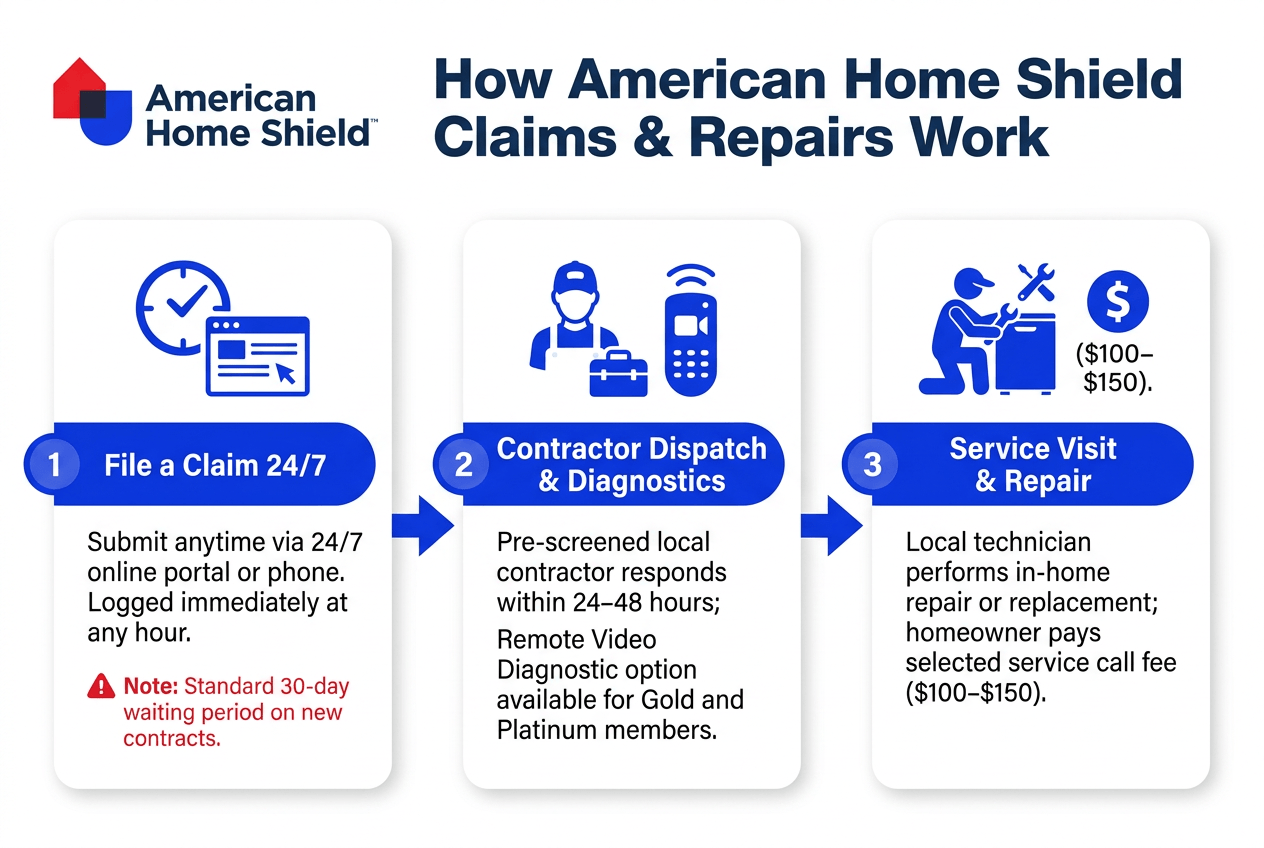
Filing a claim with American Home Shield happens online or by phone, and the portal runs continuously, so a broken air conditioner at midnight actually gets logged right away rather than waiting for business hours. New contracts carry a standard 30-day waiting period before any claim can be filed, worth knowing if you're signing up right before an anticipated repair.
Once a claim goes through, a pre-screened local contractor typically responds within 24 to 48 hours. Gold and Platinum members also get a video diagnostic option, letting a technician assess certain issues remotely before deciding whether an in-person visit is necessary. Straightforward repairs move quickly, but larger jobs can drag out, and that's genuinely where most negative reviews cluster.
Coverage, Exclusions, and Real Limits
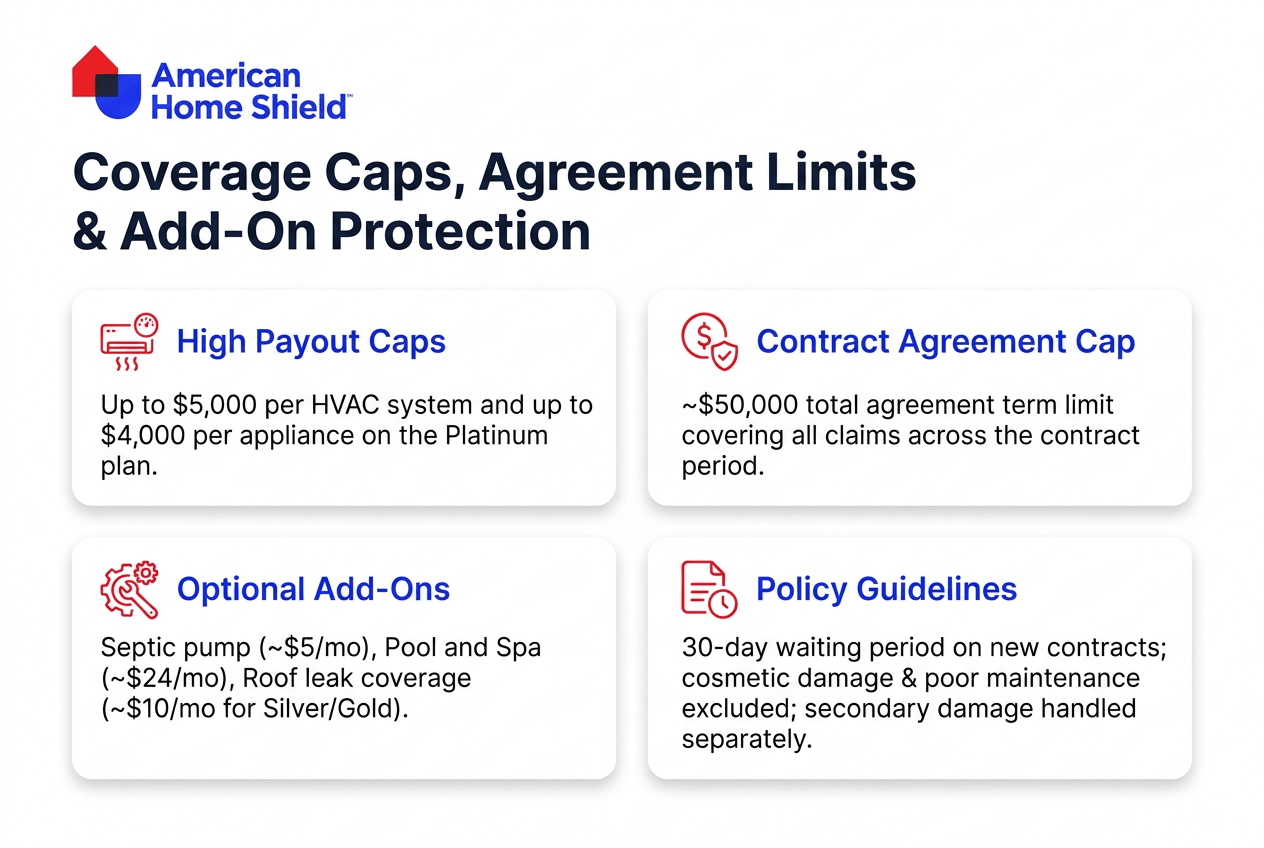
Covered systems include HVAC, plumbing, and electrical depending on your tier, with Gold and Platinum adding major kitchen and laundry appliances on top. Payout caps run higher than a lot of competitors, up to $5,000 per HVAC system and up to $4,000 per appliance on the Platinum plan specifically.
Cosmetic damage isn't covered, and neither is damage from poor maintenance. Secondary damage connected to a covered breakdown gets handled separately, and code-required upgrades during a repair typically fall outside coverage too, though Platinum sometimes includes a small allowance for that. There's also a total agreement term limit, often cited around $50,000, covering everything filed across the entire contract rather than resetting per claim.
American Home Shield Pros and Cons
| Pros | Cons |
|---|---|
| Highest coverage caps among major competitors, especially Platinum | First-contact response is slower than some rivals |
| Choice of service fee lets you control monthly cost | Contractor quality varies noticeably depending on your area |
| Largest contractor network, active in all 50 states | Complex, larger repairs sometimes see real delays |
| Online claims filing and account management is genuinely simple | Total contract term limit caps lifetime payouts |
| Three tiers let coverage scale with your home's age | Add-ons increase the monthly bill quickly |
Is It Actually Worth It?
Worth it if your home is older and its systems or appliances are more likely to need real repairs, since the higher coverage caps pay off in exactly that situation. It also suits homeowners who want to customize their plan rather than accept a one-size-fits-all deal, picking a service fee and add-ons that fit their budget.
It's a weaker fit if claims speed matters more than coverage depth, or if your budget can't stretch past the cheapest tier from a competitor. Getting an actual quote for your address is the only way to know where you land, since national averages rarely match checkout pricing.
Frequently Asked Questions
Is American Home Shield a legitimate company?
Yes, it's the oldest company in the home warranty industry, operating continuously since 1971, and it's nowhere close to a fly-by-night operation.
What does American Home Shield actually cover?
Coverage depends on your plan tier, home systems like HVAC, plumbing, and electrical are standard, while kitchen and laundry appliances get added once you move up to Gold or Platinum.
Does American Home Shield actually pay out on claims?
Yes, the company has paid out billions over the years, though individual experiences shift depending on your contractor and how complicated the specific repair turns out to be.
How much does American Home Shield typically cost?
Usually $50 to $85 a month depending on your plan and location, plus whichever service call fee you select at signup.
Is American Home Shield better than Choice Home Warranty?
It depends on your priorities. American Home Shield goes deeper on coverage tiers and payout caps, while Choice Home Warranty tends to win on price and claims speed.
Final Verdict
Longevity and coverage depth are really what earn American Home Shield its reputation, backed up by higher payout caps and a genuinely massive contractor network spanning all 50 states. That combination matters most for homeowners with older systems likely to actually need repairs.
The trade-offs are real too, a slower initial response than some competitors, and contractor quality depending more on your location than anyone would prefer. Homeowners who value customization and coverage depth over rock-bottom price are likely to find genuine value here, while budget-focused shoppers chasing the fastest claims resolution might find a competitor fits better. Either way, pulling an actual quote for your address beats relying on any national average.