

A single emergency vet visit can run into the thousands, and that math is exactly why pet insurance stopped being optional for a lot of owners. Lemonade built its reputation on making that decision less painful, low starting prices, an app that handles almost everything, and claims that sometimes get approved in minutes rather than weeks.
But a slick app doesn't automatically mean the coverage is deep enough for your pet. We broke down what Lemonade actually covers, what it costs in practice, and who ends up better served looking elsewhere.
Benefits of Choosing Lemonade Pet Insurance
- Entry pricing starts lower than most traditional pet insurers
- Claims submit entirely through the app, no paperwork or mailing receipts
- AI-assisted claims processing that can approve simple cases almost instantly
- Customizable reimbursement and deductible options rather than one fixed structure
- A giveback program that donates unused premiums to charities the policyholder picks
What Lemonade Pet Insurance Actually Is
Lemonade entered the pet insurance space as a digital-first alternative to the traditional, paperwork-heavy insurers that have dominated the category for decades. Everything from getting a quote to filing a claim happens inside the app, and the company leans hard on AI to speed up the parts of insurance that usually take the longest.
At its core, the policy covers accidents and illnesses for both dogs and cats, with optional add-ons layered on top for owners who want broader protection. That base-plus-add-ons structure is really the whole philosophy behind Lemonade, pay for what you actually need rather than a bundled package with costs baked in for coverage you'll never use.
How the Coverage Actually Works
Getting covered starts with a monthly premium, and from there you can visit any licensed vet when something comes up. After the visit, you submit the claim through the app, snap a photo of the invoice, and Lemonade calculates your reimbursement based on the plan you picked.
Reimbursement typically lands at 70%, 80%, or 90% of the vet bill, and deductibles usually range between $100 and $500 depending on what you choose at signup. Annual coverage limits can reach as high as $100,000 on the higher tiers, though most owners never come close to that ceiling in a given year.
What's Covered, and What Isn't
The Standard Policy
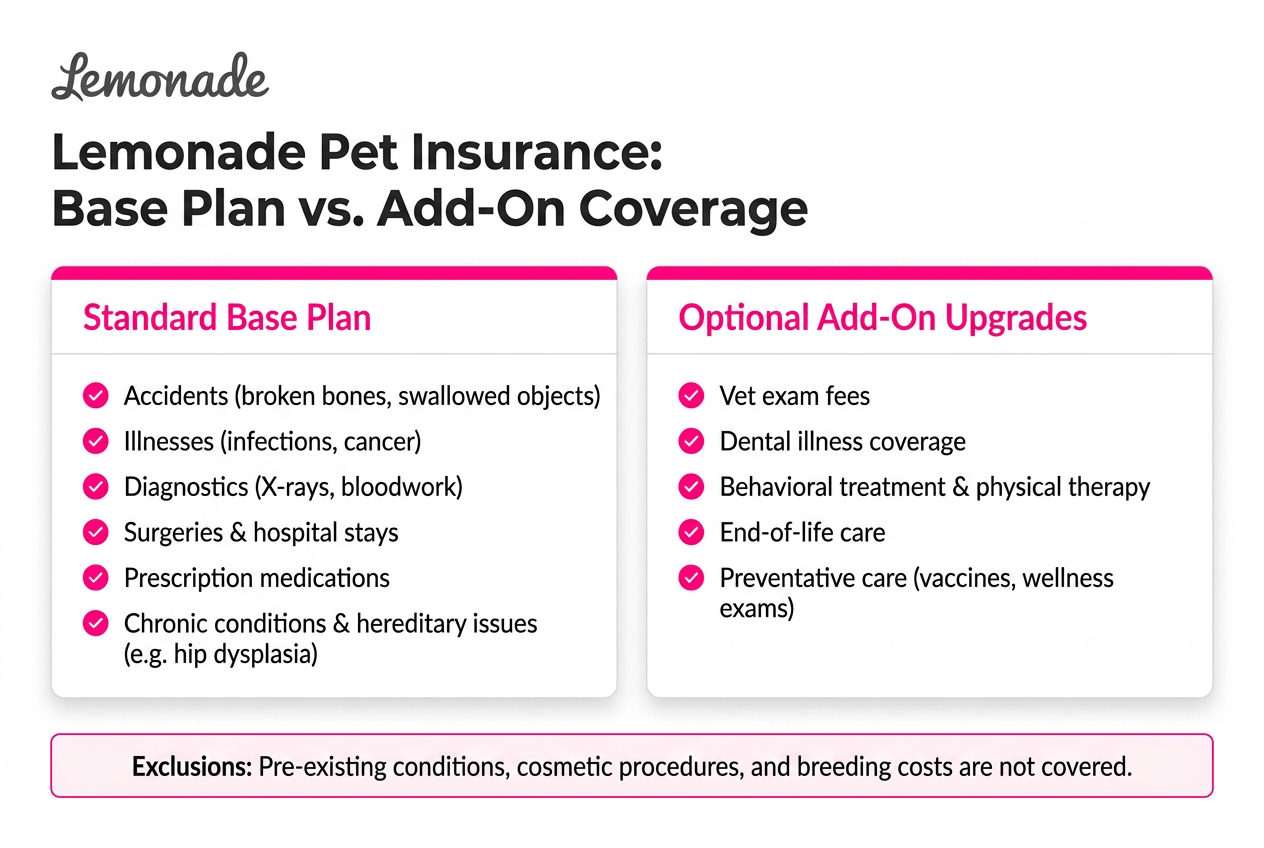
A base plan typically covers accidents like broken bones or swallowed objects, illnesses ranging from infections to cancer, diagnostic work such as X-rays and bloodwork, surgeries, hospital stays, and prescription medications. Chronic conditions and certain hereditary issues, like hip dysplasia, are included too, which isn't universal across every competitor.
Add-Ons Worth Knowing About
Vet exam fees, dental illness coverage, behavioral treatment, physical therapy, and end-of-life care sit outside the base plan as optional upgrades. Preventative care packages, covering vaccinations, wellness exams, and routine testing, are also available separately. Each add-on raises the premium, so a fully comprehensive plan costs more than the advertised entry price suggests.
What Lemonade Won't Cover
Pre-existing conditions are excluded, as they are with essentially every pet insurer. Cosmetic procedures, breeding-related costs, and routine care that hasn't been specifically added on also fall outside standard coverage. Reading the exclusion list before enrolling an older pet with a known condition saves a lot of frustration down the line.
Real Pricing Numbers for 2026
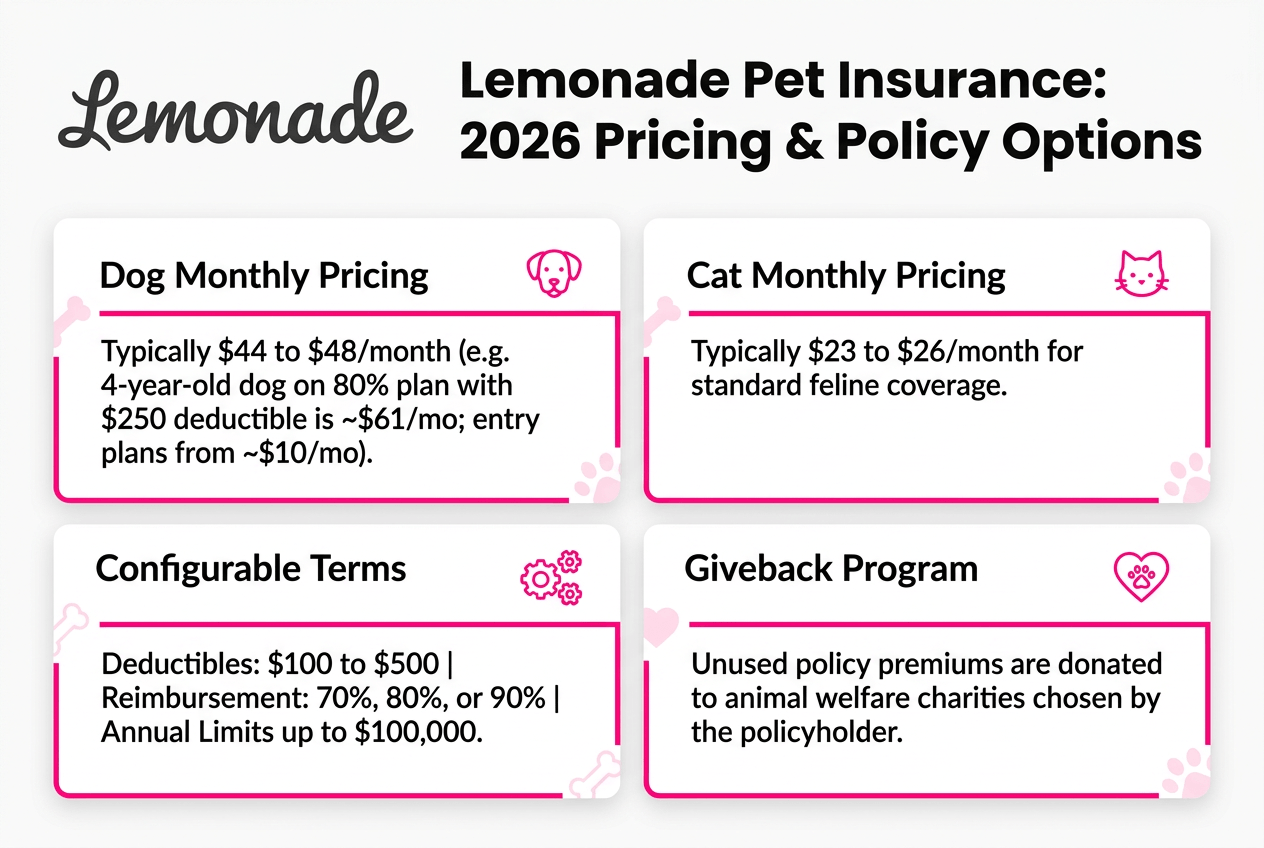
Monthly costs for dogs typically run around $44 to $48, while cats land closer to $23 to $26. Entry-level plans can start as low as $10 a month depending on how bare-bones the coverage is, though a genuinely useful policy usually costs more once you factor in a reasonable deductible and reimbursement rate.
A real example helps here, a 4-year-old dog on an 80% reimbursement plan with a $250 deductible runs around $61 a month. Breed, age, location, coverage level, and add-ons all move that number, so treat advertised entry prices as a floor rather than a realistic monthly average.
Lemonade vs. Competitors
| Parameter | Lemonade | Trupanion | Healthy Paws |
|---|---|---|---|
| Starting Price | Roughly $10/month entry tier | Generally higher, no low-tier entry option | Comparable mid-range starting point |
| Claims Speed | AI-assisted, sometimes instant approval | Manual review, typically a few days | Manual review, a few days on average |
| Customization | High, adjustable deductible and reimbursement | Moderate, fewer configurable options | Limited, more standardized plans |
| Annual Limit | Up to $100,000 on higher tiers | Unlimited on most plans | Unlimited on most plans |
| Best For | Budget-conscious, tech-savvy owners | Owners wanting no payout ceiling | Owners wanting a simpler, set plan |
Trupanion and Healthy Paws both offer unlimited annual payouts as a standard feature, something Lemonade caps even on its richest tier. That makes either of them a stronger pick for a pet with a serious chronic illness likely to rack up large ongoing costs. Lemonade's edge is speed and flexibility, not the deepest possible payout ceiling.
The Claims Process: Where Lemonade Stands Out

This is genuinely the area where Lemonade separates itself from older insurers. The entire process runs through the app, submission takes just a few minutes, and AI automation handles a meaningful share of straightforward claims without ever writing to a human reviewer.
That speed becomes a real advantage during a stressful vet visit, when the last thing an owner wants is a weeks-long wait to find out how much comes back. More complex claims, especially ones involving chronic conditions or larger payouts, still take longer and typically do involve human review before approval.
Lemonade Pet Insurance Pros and Cons
| Pros | Cons |
|---|---|
| Lower monthly premiums than many traditional insurers | Comprehensive coverage costs more once add-ons are included |
| Fast, app-based claims with AI-assisted approval | No unlimited annual payout option on any tier |
| Simple, modern interface that's easy to navigate | Vet bills must be paid upfront, then reimbursed |
| Flexible plan structure across deductibles and reimbursement | Pre-existing conditions are excluded, same as most insurers |
| Giveback program donates unused premiums to charity | Coverage can feel thinner than premium competitors |
Frequently Asked Questions
Is Lemonade Pet Insurance actually worth it?
For younger, healthy pets and budget-conscious owners who want a fast, app-based experience, generally yes. Owners chasing maximum coverage depth or an unlimited payout ceiling may be better served elsewhere.
How much does Lemonade Pet Insurance cost per month?
Dogs typically run $44 to $48 a month and cats around $23 to $26, though entry plans can start as low as $10 depending on coverage level and add-ons selected.
Does Lemonade cover pre-existing conditions?
No, pre-existing conditions are excluded, which is standard across nearly every pet insurance provider, not unique to Lemonade specifically.
How fast are Lemonade's claims processed?
Simple claims can be approved almost instantly through AI automation, while more complex cases involving chronic conditions typically require human review and take longer.
Does Lemonade have an annual payout limit?
Yes, annual limits can reach up to $100,000 on higher tiers, but there's no unlimited payout option, unlike some competitors such as Trupanion.
Final Verdict
Lemonade earns its reputation as one of the more accessible entry points into pet insurance, low starting prices, a genuinely fast claims process, and a mobile experience that doesn't feel like dealing with a traditional insurer. For a young, healthy pet and an owner who values speed over maximum payout depth, it's a genuinely strong option.
Where it asks for a trade-off is comprehensiveness, building out full coverage with every add-on costs more than the advertised entry price implies, and there's no unlimited payout ceiling for owners worried about a worst-case scenario. Comparing a real quote against a competitor like Trupanion before committing is worth the extra ten minutes, especially for an older pet or a breed prone to chronic conditions.